
Let Christ be the center of our life
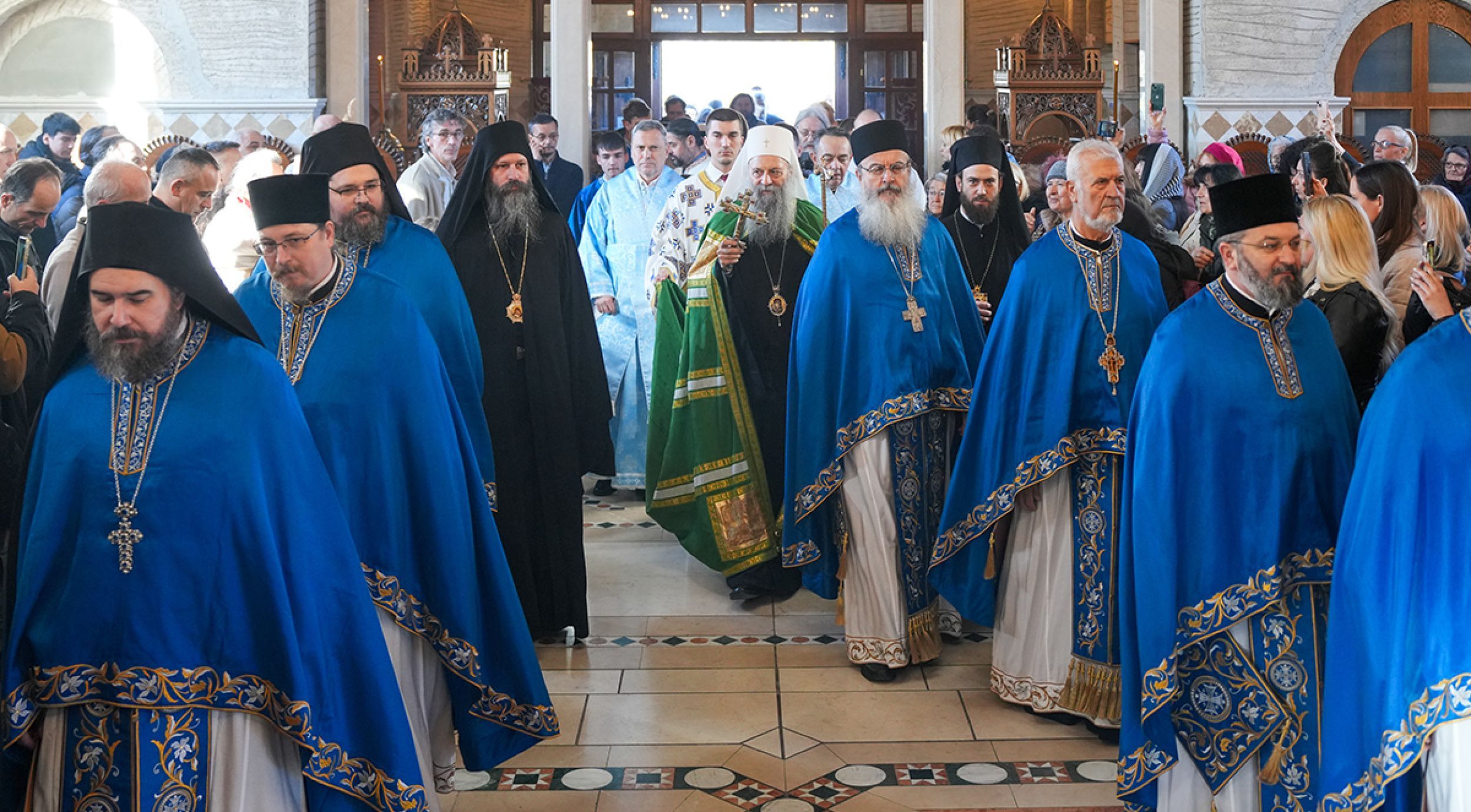
Sermon of His Holiness Serbian Patriarch kyr Porfirije, delivered on 28 February 2026, in the Church of Saint Simeon the Myrrh-Gusher in New Belgrade
In the name of the Father and of the Son and of the Holy Spirit! Brothers and sisters, the word of Christ, the word of the Gospel, is crystal clear and simple. It is so simple that each of us can not only understand it, but at the same time make it our life, make it our practice. Thus the words we have heard from today’s passages of the Holy Gospel clearly proclaim what we know and believe – that the Lord Christ is the center of the universe, that He is the beginning and the end, that He is the center of history, and that depending on how we relate to Him, our life will also be shaped.
We often ask ourselves, without understanding, why it is that sometimes we have not exerted much effort and yet everything goes well for us; while at other times, when we invest great effort, striving to fulfill God’s commandments always and everywhere, things do not turn out as we expected. Suddenly temptations arise, and it seems to us that those who do not keep God’s law, those who do not fulfill the Gospel of Christ, fare better than those – or than us – who sometimes strive to fulfill God’s law and to keep His commandments. Of course, it is clear to us that although we must outwardly adhere to God’s law and His commandments, that is not everything, and on that basis alone we still cannot know whether we are walking on God’s path. It is necessary to fast, to show mercy, it is necessary to pray to God, but all of this must be accompanied and permeated by humility, by faith that we ourselves can do nothing, by the knowledge that everything is a gift of God, that even our ability to fulfill God’s commandments is His gift, an expression of His love and His providence. In other words, that the Lord is all and in all, that without Him nothing exists, that just as He is the center of history, so too is He the center of our being.
The Lord says that whoever wishes to save his life will lose it, but whoever loses it for His sake and for the sake of His Gospel will save it. This word also is clear. It confirms precisely what we have said: whenever we wish to do anything, even if it be good and virtuous, even if it have the best possible intention, if we rely on ourselves, on our own intellect and abilities, if we rely on human resources, human science and human philosophy, this may produce results and bear certain fruits, but since it has its beginning here and now, in man, it also has its end here and now, in history.
We know many powerful and glorious figures who founded their power and glory on human principles, yet even the most powerful and the most glorious have faded away. Departing from this world, they took with them nothing of what was valuable and admired by the people around them, none of the mechanisms by which they held processes in submission and control – and even if they had taken them, it would mean nothing before the throne of the living God. What they took with them is what they truly were, what constituted their personhood, what was permeated by the grace of God, what was founded upon the Gospel of Christ. That is what went with them. In other words, everything that is bound to the Lord, everything that is bound to His Gospel, remains and determines our place in the nearness of God. Therefore, all that is Christ’s remains; it becomes eternal, it receives its infinity, and it also becomes without beginning. That is why it is not important how long we have lived, nor where or when we have lived, but rather for what we have lived and why we have lived.
There are only two principles around which our entire life is woven. One is the Christ-centered principle, and the other is the demon-centered principle. Whoever wishes to save his soul or his life will lose it, but if he loses it for Christ’s sake, then he will gain it. To lose one’s life for Christ’s sake, to deny oneself, does not mean to cease to exist; it does not mean to cease to have one’s own will. Renouncing one’s will does not mean that I cease to desire or to want something. Rather, we can deny ourselves and our will by identifying our will with demonic powers, but then we grant demonic powers the right to govern our lives. And of course, our mind becomes darkened. Then we often think that we are serving God, for it may be that outwardly we fulfill God’s law; but if we rely on our own will – that is, on our egocentrism and self-love – then our love is not love dedicated to Christ and through Him to our neighbor. Then we grant authority to, we subject ourselves to, we become slaves of demonic powers, and this is manifested in our passionate life, which again and again culminates in self-love, pride, narcissism. We then align everything with our distorted and twisted image of God, the world, and man, and we conform everything to our selfish, passionate needs, and at its root we make ourselves similar to demonic powers.
To deny oneself, to cut off one’s will, does not mean to cease to exist; but for it to be free, true, and authentic means to make it the will of Christ, just as we say countless times daily in prayer: Our Father, Thy will be done, and that according to the order that is in heaven, according to those rules. This is what the saints of God did, brothers and sisters. Such was the great father of Saint Sava, Saint Simeon. He too had everything – strength, power, and glory – but in the end he made all of that become the glory of God by following in the footsteps of his son, the holy and grace-filled son, making Christ’s will his own will, making his life entirely for Christ, and Christ for nothing.
Therefore, brothers and sisters, let the Lord Christ be the center of our life. This is what we have chosen, and let us firmly hold to it, for there is no crisis other than a spiritual crisis. There is no economic crisis, no political crisis, no social crisis, no psychological crisis – or rather, all of these exist because there is a spiritual crisis. Where greed, selfishness, and self-indulgence prevail, there is spiritual failure, there is a spiritual crisis, and of course from that spiritual disorder every other disorder will arise. But where the Lord is, there is health, there is truth, there is justice, beauty, and freedom. And therefore, as we celebrate Saint Simeon today, let us follow his example and place Christ at the center of our life and glorify Him together with His Father and the Holy Spirit, knowing that when we walk His path, we will not be dear to the world that lies in evil; we will be rejected, we will be despised, but we shall know that He is our God, and that we too are with Him in His glory, now and ever and unto the ages of ages. Amen.
In the name of the Father and of the Son and of the Holy Spirit! Brothers and sisters, the word of Christ, the word of the Gospel, is crystal clear and simple. It is so simple that each of us can not only understand it, but at the same time make it our life, make it our practice. Thus the words we have heard from today’s passages of the Holy Gospel clearly proclaim what we know and believe – that the Lord Christ is the center of the universe, that He is the beginning and the end, that He is the center of history, and that depending on how we relate to Him, our life will also be shaped.
We often ask ourselves, without understanding, why it is that sometimes we have not exerted much effort and yet everything goes well for us; while at other times, when we invest great effort, striving to fulfill God’s commandments always and everywhere, things do not turn out as we expected. Suddenly temptations arise, and it seems to us that those who do not keep God’s law, those who do not fulfill the Gospel of Christ, fare better than those – or than us – who sometimes strive to fulfill God’s law and to keep His commandments. Of course, it is clear to us that although we must outwardly adhere to God’s law and His commandments, that is not everything, and on that basis alone we still cannot know whether we are walking on God’s path. It is necessary to fast, to show mercy, it is necessary to pray to God, but all of this must be accompanied and permeated by humility, by faith that we ourselves can do nothing, by the knowledge that everything is a gift of God, that even our ability to fulfill God’s commandments is His gift, an expression of His love and His providence. In other words, that the Lord is all and in all, that without Him nothing exists, that just as He is the center of history, so too is He the center of our being.
The Lord says that whoever wishes to save his life will lose it, but whoever loses it for His sake and for the sake of His Gospel will save it. This word also is clear. It confirms precisely what we have said: whenever we wish to do anything, even if it be good and virtuous, even if it have the best possible intention, if we rely on ourselves, on our own intellect and abilities, if we rely on human resources, human science and human philosophy, this may produce results and bear certain fruits, but since it has its beginning here and now, in man, it also has its end here and now, in history.
We know many powerful and glorious figures who founded their power and glory on human principles, yet even the most powerful and the most glorious have faded away. Departing from this world, they took with them nothing of what was valuable and admired by the people around them, none of the mechanisms by which they held processes in submission and control – and even if they had taken them, it would mean nothing before the throne of the living God. What they took with them is what they truly were, what constituted their personhood, what was permeated by the grace of God, what was founded upon the Gospel of Christ. That is what went with them. In other words, everything that is bound to the Lord, everything that is bound to His Gospel, remains and determines our place in the nearness of God. Therefore, all that is Christ’s remains; it becomes eternal, it receives its infinity, and it also becomes without beginning. That is why it is not important how long we have lived, nor where or when we have lived, but rather for what we have lived and why we have lived.
There are only two principles around which our entire life is woven. One is the Christ-centered principle, and the other is the demon-centered principle. Whoever wishes to save his soul or his life will lose it, but if he loses it for Christ’s sake, then he will gain it. To lose one’s life for Christ’s sake, to deny oneself, does not mean to cease to exist; it does not mean to cease to have one’s own will. Renouncing one’s will does not mean that I cease to desire or to want something. Rather, we can deny ourselves and our will by identifying our will with demonic powers, but then we grant demonic powers the right to govern our lives. And of course, our mind becomes darkened. Then we often think that we are serving God, for it may be that outwardly we fulfill God’s law; but if we rely on our own will – that is, on our egocentrism and self-love – then our love is not love dedicated to Christ and through Him to our neighbor. Then we grant authority to, we subject ourselves to, we become slaves of demonic powers, and this is manifested in our passionate life, which again and again culminates in self-love, pride, narcissism. We then align everything with our distorted and twisted image of God, the world, and man, and we conform everything to our selfish, passionate needs, and at its root we make ourselves similar to demonic powers.
To deny oneself, to cut off one’s will, does not mean to cease to exist; but for it to be free, true, and authentic means to make it the will of Christ, just as we say countless times daily in prayer: Our Father, Thy will be done, and that according to the order that is in heaven, according to those rules. This is what the saints of God did, brothers and sisters. Such was the great father of Saint Sava, Saint Simeon. He too had everything – strength, power, and glory – but in the end he made all of that become the glory of God by following in the footsteps of his son, the holy and grace-filled son, making Christ’s will his own will, making his life entirely for Christ, and Christ for nothing.
Therefore, brothers and sisters, let the Lord Christ be the center of our life. This is what we have chosen, and let us firmly hold to it, for there is no crisis other than a spiritual crisis. There is no economic crisis, no political crisis, no social crisis, no psychological crisis – or rather, all of these exist because there is a spiritual crisis. Where greed, selfishness, and self-indulgence prevail, there is spiritual failure, there is a spiritual crisis, and of course from that spiritual disorder every other disorder will arise. But where the Lord is, there is health, there is truth, there is justice, beauty, and freedom. And therefore, as we celebrate Saint Simeon today, let us follow his example and place Christ at the center of our life and glorify Him together with His Father and the Holy Spirit, knowing that when we walk His path, we will not be dear to the world that lies in evil; we will be rejected, we will be despised, but we shall know that He is our God, and that we too are with Him in His glory, now and ever and unto the ages of ages. Amen.
Најновије вести
20.03.2026 13:24