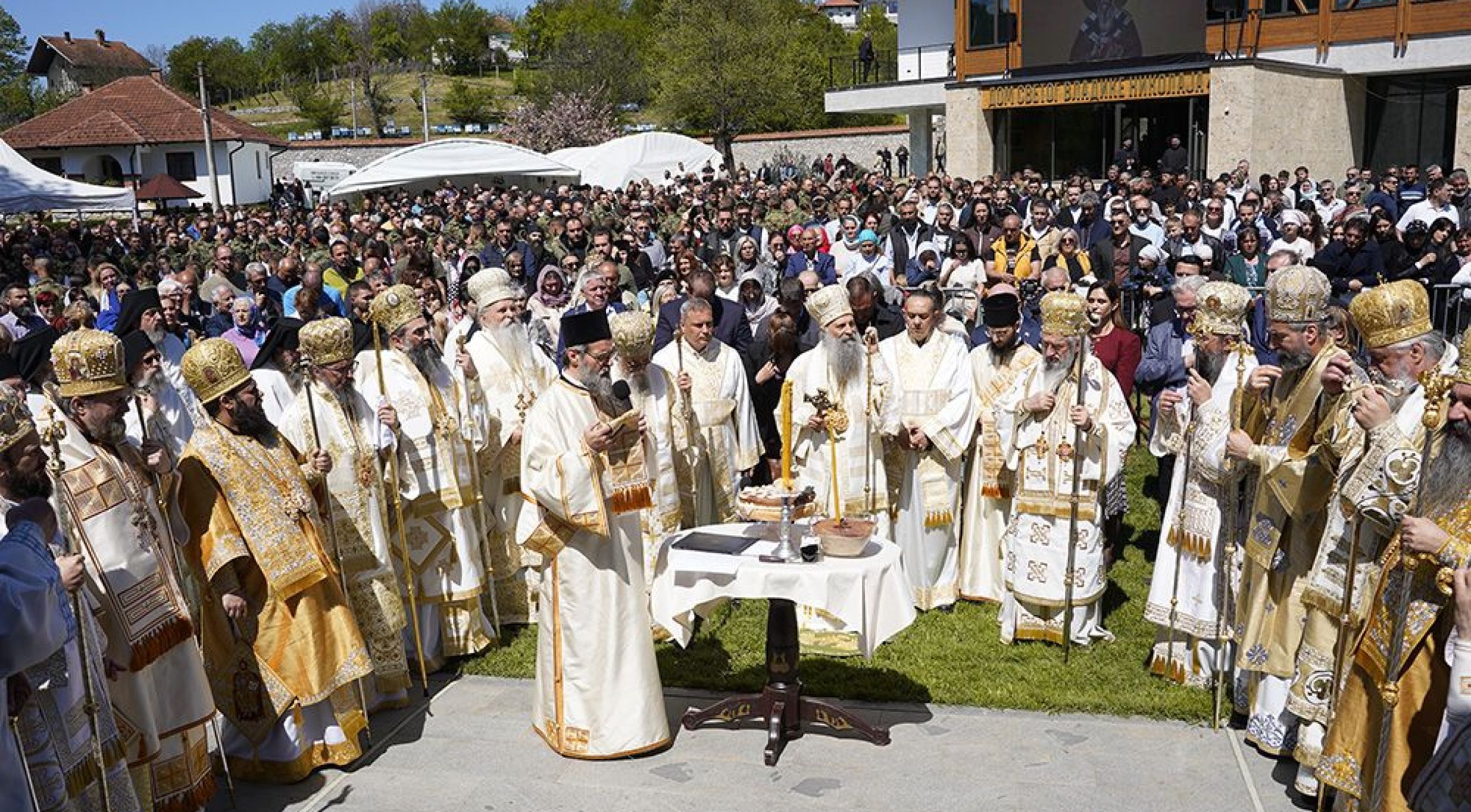
Gathered in Lelić, we show that we are the children of Saint Bishop Nikolaj, the children of Saint Sava, the Church of Christ and the people of God
Christ is risen! Truly the Lord is risen, brothers and sisters, and by His Resurrection He once and for all made clear, confirmed, and revealed that we are created for life and that death is not natural or normal for the human being. Therefore, brothers and sisters, we are filled with inexpressible joy and gratitude toward our Lord, and today especially, because in the joy of the Resurrection – in the joy of the triumph of life, beauty, love, meaning, and virtue – He has gathered us here, in this holy place, before the relics of Saint Bishop Nikolaj, on the day when we prayerfully commemorate him and, together with him, glorify our Lord.
Saint Bishop Nikolaj is in our people loved, cherished, honored, and glorified as one of the holiest among our kin. Many say that Saint Sava planted deep the root of the Orthodox faith in our people, and that then many venerable ones, saints, martyrs, hierarchs, numerous known and unknown from our people, not only preserved and multiplied that faith, but lived by it and left spiritual fruits by which we are nourished even today. And one of those whom many among us consider the greatest after Saint Sava is precisely Saint Bishop Nikolaj, who has gathered us in this holy place in Lelić, on this beautiful, sunny, and blessed day, on the Sunday of the Paralytic – a Sunday that reminds us what this world is, what the human race is, and what each one of us is.
Namely, in the passage from the Gospel about the paralytic, we heard the story that mentions the pool of Bethesda as a place of healing, as a place of salvation, but as a place of healing that was confirmed and manifested as such only one day in the year, and that on the day when an angel of the Lord descended into the water, granting it miraculous power, and it would heal once a year only one person. Only the one who first entered the water would be healed. And we see a striking image, a dramatic image – one might say a tragic image. We see a pool in which a multitude of people are gathered: the deaf, the mute, the poor, the blind, the demon-possessed, those afflicted with various diseases. And all those gathered await that day and that moment, pushing and striving to be the first to enter the water, for only such a one would be healed. And there among them is a man who has been ill for thirty-eight years. From the end of the story we see that he is physically ill, but that his physical illness is caused by sin. In other words, we see that he is spiritually ill as well.
For thirty-eight years he has been coming there, but he is powerless, weakened; he does not have the strength to enter the water by himself. And the Lord sees him, recognizes in him persistence, a refusal to give up on being healed. He recognizes in him endurance – and that means also faith that he can be healed. He approaches him and does not ask: “Do you want me to heal you?” but rather: “Do you want to be made well? Do you wish to be well?” Of course, that question could seem offensive, because if he has been there for thirty-eight years and persistently comes, it means that he does want and desire to be well. But with these words of the Lord, “Do you want to be made well?”, the Lord wishes to draw out from this sick man a public, clear, and audible confession that he desires to be well, that he has faith, that he has hope. And therefore He asks him: “Do you want to be made well?” And the man answers sadly that he does, but that he has no one to help him enter the water and be healed.
On the one hand, then, we see that everyone is striving and thinking only of themselves. They are filled above all with concern that they themselves should be well. One might say that egoism outweighs the sense of the neighbor’s suffering. Each, therefore, thinks of himself, and each wants to be the first to enter the water. But this man has no one. And truly, brothers and sisters, if we speak of our greatest problem in the light of the feast of Christ’s Resurrection, truly there is no man! A person cannot be healed by himself and from himself alone. In the end, a person cannot, by his own powers and abilities – whoever he may be, whatever skills he may possess – overcome his greatest enemy, which is death. And behold, the Lord accomplishes this by rising from the dead, and before that by becoming man. Yet often we have no one even for our most basic needs. We have no one who will understand us, no one on whose shoulder we can lay our sorrow, our soul, our head. Often we have no one.
We might ask ourselves what kind of man this was, who for thirty-eight years comes and yet has no one to help him. What must he have been like, if no one wanted to help him? And we often ask why there is no help from anywhere and from anyone, but we do not ask whether perhaps by our own life, our own actions, our own attitude toward our neighbors, we too have deserved that no one pays attention to us. Regardless of this, brothers and sisters, however fallen we may be, however sick, however helpless, however much we may have deserved to have no help – and even when everyone abandons us – if we have hope and if we have faith within us, there is a Man! There exists the God-Man, the Son of God who became man, and if there is faith within us we will never be left alone. Where there is faith, He will heal our inner illness – our passions, egoism, and self-love – and then He will also heal everything that is a consequence of those inner illnesses, which is visible outwardly.
But there is, brothers and sisters, a Man! There are also people who are Christ’s people; there are God’s saints who are deified and who are likewise always with us. And they work miracles, they heal, they help, they understand us. They are with us when there is faith within us, when we approach them not in a magical way or, God forbid, with pride, thinking that they are obliged to help us, but because they were humble and became like Christ. The Lord has them as angels who descend into the pool of Bethesda, into the water beside which we too – sinful and erring – stand; they descend and lead us in and heal us. Such, brothers and sisters, is also the saint of God whom we celebrate today – Saint Bishop Nikolaj, who united prayer and thought, who united East and West, who brought together people separated by ideas and ideologies, who made the faith of the simple people one with the most profound and wise faith of great theologians, who himself took up his cross and followed Christ, was crucified, so that the Lord, by His Resurrection, might also raise him up among us, and that from a distant land, across seven seas and seven mountains, he might return to his birthplace and make it, behold, a pool of Bethesda, so that we too, coming here today like that unfortunate man sick for thirty-eight years – sick from our sins, from passions, from hatred, from ill will, from mutual intolerance – recognizing the love of Saint Bishop Nikolaj for God, his and our God, and his love for his people, praying together with him in this pool of Bethesda, may always be healed through his prayers.
And this we can do if we wish. We can do this if we have faith, hope, and love, and the very fact that we are gathered here shows that we are indeed the children of Saint Bishop Nikolaj, the children of Saint Sava, and thereby the Church of Christ, the people of God. Therefore, brothers and sisters, may the Lord grant that we remain so and always gather here, and may He grant us faith, hope, and love, so that we may glorify Him – together with all the saints, led by Saint Sava, Saint Bishop Nikolaj, and Saint Father Justin – Him, the One God in Trinity, now and ever and unto the ages of ages. Amen.
Saint Bishop Nikolaj is in our people loved, cherished, honored, and glorified as one of the holiest among our kin. Many say that Saint Sava planted deep the root of the Orthodox faith in our people, and that then many venerable ones, saints, martyrs, hierarchs, numerous known and unknown from our people, not only preserved and multiplied that faith, but lived by it and left spiritual fruits by which we are nourished even today. And one of those whom many among us consider the greatest after Saint Sava is precisely Saint Bishop Nikolaj, who has gathered us in this holy place in Lelić, on this beautiful, sunny, and blessed day, on the Sunday of the Paralytic – a Sunday that reminds us what this world is, what the human race is, and what each one of us is.
Namely, in the passage from the Gospel about the paralytic, we heard the story that mentions the pool of Bethesda as a place of healing, as a place of salvation, but as a place of healing that was confirmed and manifested as such only one day in the year, and that on the day when an angel of the Lord descended into the water, granting it miraculous power, and it would heal once a year only one person. Only the one who first entered the water would be healed. And we see a striking image, a dramatic image – one might say a tragic image. We see a pool in which a multitude of people are gathered: the deaf, the mute, the poor, the blind, the demon-possessed, those afflicted with various diseases. And all those gathered await that day and that moment, pushing and striving to be the first to enter the water, for only such a one would be healed. And there among them is a man who has been ill for thirty-eight years. From the end of the story we see that he is physically ill, but that his physical illness is caused by sin. In other words, we see that he is spiritually ill as well.
For thirty-eight years he has been coming there, but he is powerless, weakened; he does not have the strength to enter the water by himself. And the Lord sees him, recognizes in him persistence, a refusal to give up on being healed. He recognizes in him endurance – and that means also faith that he can be healed. He approaches him and does not ask: “Do you want me to heal you?” but rather: “Do you want to be made well? Do you wish to be well?” Of course, that question could seem offensive, because if he has been there for thirty-eight years and persistently comes, it means that he does want and desire to be well. But with these words of the Lord, “Do you want to be made well?”, the Lord wishes to draw out from this sick man a public, clear, and audible confession that he desires to be well, that he has faith, that he has hope. And therefore He asks him: “Do you want to be made well?” And the man answers sadly that he does, but that he has no one to help him enter the water and be healed.
On the one hand, then, we see that everyone is striving and thinking only of themselves. They are filled above all with concern that they themselves should be well. One might say that egoism outweighs the sense of the neighbor’s suffering. Each, therefore, thinks of himself, and each wants to be the first to enter the water. But this man has no one. And truly, brothers and sisters, if we speak of our greatest problem in the light of the feast of Christ’s Resurrection, truly there is no man! A person cannot be healed by himself and from himself alone. In the end, a person cannot, by his own powers and abilities – whoever he may be, whatever skills he may possess – overcome his greatest enemy, which is death. And behold, the Lord accomplishes this by rising from the dead, and before that by becoming man. Yet often we have no one even for our most basic needs. We have no one who will understand us, no one on whose shoulder we can lay our sorrow, our soul, our head. Often we have no one.
We might ask ourselves what kind of man this was, who for thirty-eight years comes and yet has no one to help him. What must he have been like, if no one wanted to help him? And we often ask why there is no help from anywhere and from anyone, but we do not ask whether perhaps by our own life, our own actions, our own attitude toward our neighbors, we too have deserved that no one pays attention to us. Regardless of this, brothers and sisters, however fallen we may be, however sick, however helpless, however much we may have deserved to have no help – and even when everyone abandons us – if we have hope and if we have faith within us, there is a Man! There exists the God-Man, the Son of God who became man, and if there is faith within us we will never be left alone. Where there is faith, He will heal our inner illness – our passions, egoism, and self-love – and then He will also heal everything that is a consequence of those inner illnesses, which is visible outwardly.
But there is, brothers and sisters, a Man! There are also people who are Christ’s people; there are God’s saints who are deified and who are likewise always with us. And they work miracles, they heal, they help, they understand us. They are with us when there is faith within us, when we approach them not in a magical way or, God forbid, with pride, thinking that they are obliged to help us, but because they were humble and became like Christ. The Lord has them as angels who descend into the pool of Bethesda, into the water beside which we too – sinful and erring – stand; they descend and lead us in and heal us. Such, brothers and sisters, is also the saint of God whom we celebrate today – Saint Bishop Nikolaj, who united prayer and thought, who united East and West, who brought together people separated by ideas and ideologies, who made the faith of the simple people one with the most profound and wise faith of great theologians, who himself took up his cross and followed Christ, was crucified, so that the Lord, by His Resurrection, might also raise him up among us, and that from a distant land, across seven seas and seven mountains, he might return to his birthplace and make it, behold, a pool of Bethesda, so that we too, coming here today like that unfortunate man sick for thirty-eight years – sick from our sins, from passions, from hatred, from ill will, from mutual intolerance – recognizing the love of Saint Bishop Nikolaj for God, his and our God, and his love for his people, praying together with him in this pool of Bethesda, may always be healed through his prayers.
And this we can do if we wish. We can do this if we have faith, hope, and love, and the very fact that we are gathered here shows that we are indeed the children of Saint Bishop Nikolaj, the children of Saint Sava, and thereby the Church of Christ, the people of God. Therefore, brothers and sisters, may the Lord grant that we remain so and always gather here, and may He grant us faith, hope, and love, so that we may glorify Him – together with all the saints, led by Saint Sava, Saint Bishop Nikolaj, and Saint Father Justin – Him, the One God in Trinity, now and ever and unto the ages of ages. Amen.
Најновије вести
29.05.2026 19:36